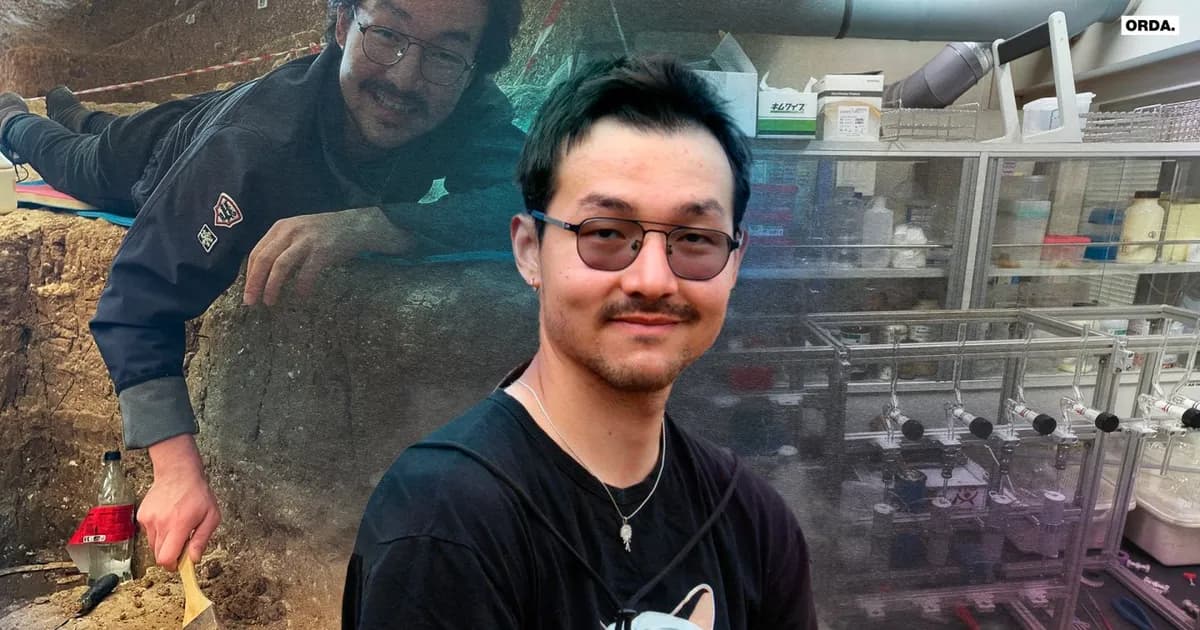
Young scientist Dauren Kissabayev is studying archaeology in Japan and plans to return to Kazakhstan to develop national science, reports Todayinfo news agency.
Dauren's interest in archaeology was sparked by his father. Although not a scientist, his father worked as a photographer of ancient artifacts at the Central State Museum of Kazakhstan. Spending days at the museum as a child, Dauren later deepened his passion for humanity's past during archaeological excavations with professors from Nazarbayev University.
“My father, though not a scientist, was the one who awakened my interest in archaeology. It all started in early childhood when I spent entire days at the National Central Museum of Kazakhstan, where he worked as a photographer of ancient artifacts. Later, my interest in humanity's past strengthened during archaeological excavations with professors from Nazarbayev University,” Dauren recalls.
He feels happiest during expeditions in the steppes and caves, especially when valuable artifacts are found. However, archaeologists spend much of their time in laboratories conducting experiments, analyzing finds, and testing hypotheses. “Our finds are tangible past that cannot be replaced. If you ask the right question, bones and stones can tell more than people,” he notes.
Dauren believes archaeology is crucial for the country, particularly for debunking national myths and historically incorrect interpretations. “Archaeology is a 'brand' of the country. Tanbaly Tas, Golden Man, ancient Otrar, Botai, Saka, and Wusun cultures are the foundation for modern nation-building. But these discoveries are not the end; many more findings lie ahead,” he says.
Currently, Dauren is engaged in archaeology in Japan. According to him, scientists speak the same language, so no difficulties arise. “Representatives of any scientific field share a common goal—explaining the laws of nature. In this sense, we are the same. For example, Japanese people, like Kazakhs, love making toasts at celebrations,” he shares.
Regarding differences between Japanese and Kazakhstani approaches, Dauren notes that in Japan, young employees are trusted with serious work from the start and treated as full participants in the research process. Funding also differs: each laboratory in Japan is well-equipped with everything needed. “I don't even sharpen pencils myself—a machine does it. Yesterday, during a geophysics course, we measured gravity on each floor. The instructor handed me a device and calmly said, 'It costs 10 million yen,'” he recalls.
However, the Japanese system, he observes, remains extremely conservative and not very receptive to change. He was surprised that some old computers still run Windows XP. But, as he notes, if the system continues to work effectively, it doesn't matter. Dauren plans to return to Kazakhstan and apply his knowledge and experience to develop archaeology in the country.