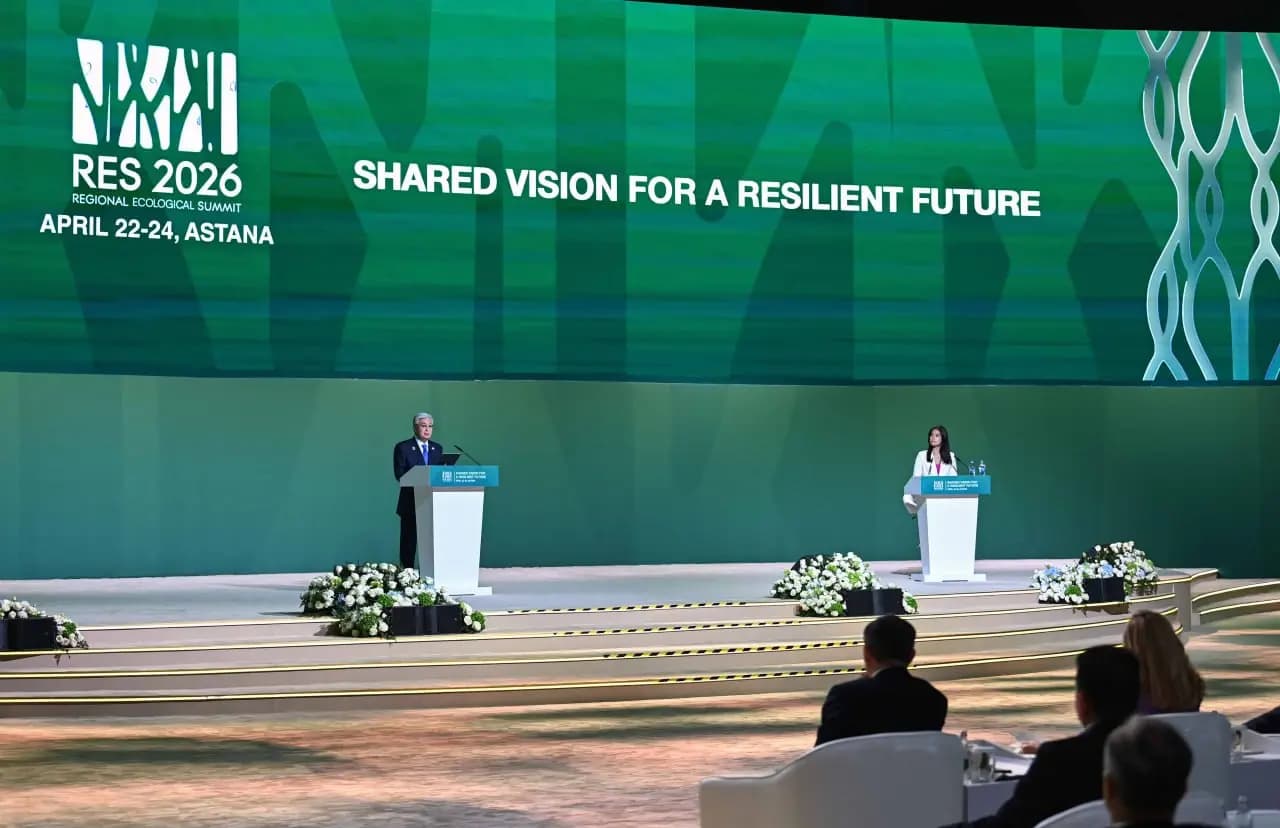
President of Kazakhstan Kassym-Jomart Tokayev spoke at the plenary session of the Regional Environmental Summit in Astana as part of Earth Day. The head of state emphasized the importance of the platform for developing a common approach to sustainable development and environmental security.
Welcoming the heads of delegations and summit participants, the President noted that the countries of the region recognize the need for joint action.
“Indeed, today, on Earth Day, we have gathered in Astana to reaffirm our shared responsibility for protecting our planet. This means that the states of our region deeply realize the relevance and extreme importance of forming a common vision for a sustainable future. Modern ecology is not limited only to climate issues. It is the foundation of human existence. It is about clean air and safe water, healthy soil and a reliable food system, community stability and the well-being of future generations. It also concerns clarity of mind, social harmony, and human happiness. In this broad sense, ecology is a way of life based on a responsible attitude towards our common planet. Therefore, our summit today is a timely and necessary event,” Kassym-Jomart Tokayev stated.
The head of state also touched upon the activities of international institutions and emphasized the importance of preserving the universality of the UN Charter.
“We have gathered here in a period of growing uncertainty and unpredictability. There is no need to explain in detail how deeply and detrimentally they affect global and regional stability, as well as the quality of life of millions of people. They undermine development efforts and divert resources from solving urgent environmental problems. In this context, the role of the international community truly acquires special significance. The United Nations, created eighty years ago, remains indispensable as the only universal platform for dialogue. However, since then, the world has undergone radical and fundamental changes. Artificial intelligence has taken a dominant position in the minds of people around the world and in their daily lives. Much is said about the inviolability of the UN Charter, which remains the cornerstone of international law. However, the UN Charter is not haute cuisine, and it cannot be used as a menu from which you can choose only what you like. On the contrary, the UN Charter should be accepted and perceived as a single, comprehensive document, recognizing it as such in the fullness of its provisions. Therefore, it is necessary that the UN and other major international organizations fully take into account the realities of the modern world, which has entered an era of transformation, the nature and scale of which make them absolutely unprecedented and, therefore, unpredictable. We must avoid selective application of the principles of the UN Charter to international armed conflicts. At the same time, we must maintain unwavering faith in multilateral institutions, although, unfortunately, they lack the authority to resolve important international problems.”
In addition, the President emphasized the need for a fair approach to the ecological transition.
“From my point of view, a selective approach is unacceptable in environmental matters as well. In many cases, the environmental agenda is developed and formed without due regard for the development needs of various regions and states, especially developing ones, which are still engaged in strengthening their economic potential. Meanwhile, developed countries have achieved their current environmental standards as a result of a long process of industrialization. Therefore, the global transition to greener models must be fair, balanced, and incentivizing.
Our common approach must be sound, pragmatic, and carefully considered so that countries can move forward based on the principles of sustainable development without compromising their prospects for economic growth and progress. Cooperation in the field of environmental protection should serve as a reliable tool for unity and should not divide us. It should be based on partnership, trust, and shared responsibility – without public condemnation, reproach, or accusations.
As partners, we must act pragmatically and responsibly in the interests of peace and sustainable development,” Kassym-Jomart Tokayev emphasized.
Photo: Akorda